
WEEKLY DIGEST
Three developments define the week:

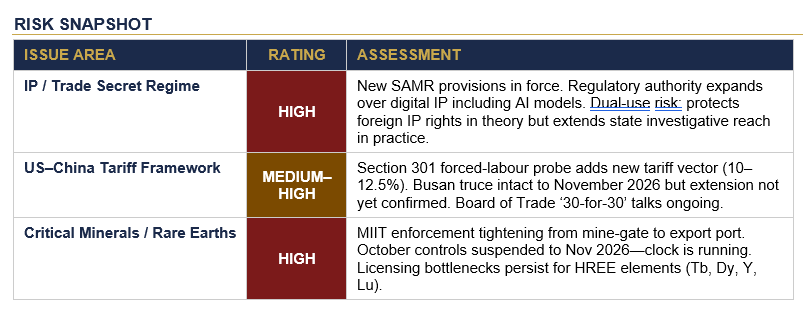
(1) China’s new trade secret regime entered force on 1 June, sharply expanding regulatory authority over AI data, algorithms, and source code—with direct implications for multinational IP governance in-country; (2) the US–China tariff framework remains unstable as Washington filed a new Section 301 forced-labour investigation and the Busan truce deadline approaches in November; (3) China’s rare earth enforcement tightened further up the value chain, shifting from export-gate controls to mine-to-market compliance oversight. Each development compounds counterparty and operational risk for foreign commercial actors.
Key Developments
• SAMR Trade Secret Provisions in Force (1 June 2026): China’s most significant IP reform in three decades extended formal trade secret protection to data, algorithms, source code, and AI-related technologies. The provisions lower the burden of proof for rights-holders but simultaneously empower market regulatory authorities with investigative powers that could be turned on foreign entities. Multinationals must review confidentiality agreements, IT access controls, and offboarding procedures with immediate effect. Offshore affiliates of Chinese entities may also now face extraterritorial exposure. Analyst assessment: net benefit to well-structured foreign rights-holders in the near term; medium-term risk lies in regulatory overreach during the ‘awareness cultivation’ campaign running through June.
• USTR Proposes 12.5% Tariff on China Under Section 301 Forced-Labour Probe (2 June 2026): The US Trade Representative proposed a new 12.5 percent tariff on China arising from a Section 301 forced-labour investigation, the second such probe launched in March 2026. This sits outside the Busan truce framework, which covers reciprocal tariff rates only. Beijing and Washington “agreed in principle” on a Board of Trade framework covering ~$30 bn of mutual imports, but forced-labour tariffs represent an uncapped escalation vector. The truce extension beyond November 2026 has not been agreed. Counterparties with PRC supply-chain exposure in textile, solar, and electronics sectors should treat this as a supply-chain stress indicator.
• China Tightens Rare Earth Enforcement Up the Value Chain (April–June 2026): MIIT’s April 2026 draft framework extends compliance penalties to mining, smelting, separation, and sales of non-quota-compliant material—moving enforcement upstream from export controls to production-stage governance. The October 2025 extraterritorial provisions remain suspended until November 2026 under Busan terms, but the licensing infrastructure is intact and expanding. HREE bottlenecks (terbium, dysprosium) continue to affect magnet, aerospace, and energy-storage supply chains. Key watch-date: November 10, 2026, when suspended controls may reinstate.
Analyst’s Note
The three developments this week share a structural logic: Beijing is consolidating regulatory authority across the domains most contested with Washington—IP, trade, and critical inputs. The SAMR trade secret expansion, read alongside the revised Foreign Trade Law (effective March 1, 2026), signals a move from reactive IP protection toward proactive strategic asset governance. For compliance practitioners, the near-term priority is not litigation risk but internal protocol exposure—particularly around employee transitions, data-sharing agreements, and AI model training datasets held onshore. The rare-earth clock is the single most material watch-item: if the Busan truce is not extended, November 2026 will see simultaneous re-imposition of October controls and an untested extraterritorial licensing architecture.
COMING NEXT WEEK
Full-length analysis: China’s Board of Trade Framework—what managed trade actually means for counterparty due diligence and market-access risk.
Full-issue subscribers receive the complete brief with sourced intelligence and the Analyst’s Annexe. Subscribe at ascendancyadvisors.substack.com