

Executive Snapshot
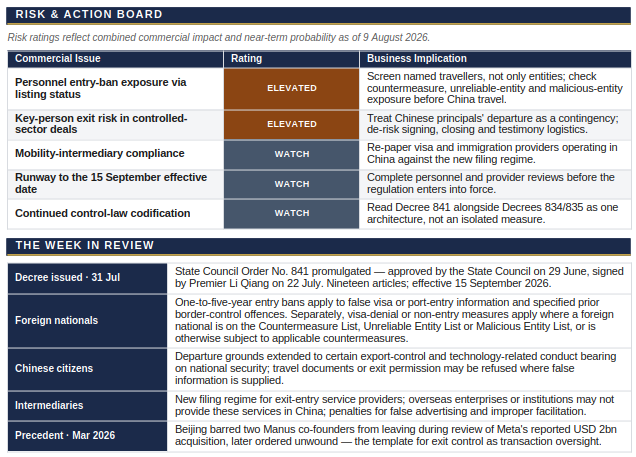
Key Assessment. On 31 July, China’s State Council issued the Regulations on Exit and Entry Administration (Decree No. 841), effective 15 September 2026. It is a nineteen-article implementing regulation under the 2012 Exit and Entry Administration Law — not a new border regime — and the “closing the country off” framing circulating since publication overstates the mechanism. The commercial substance sits in three structural shifts: immigration control is now formally wired to China’s countermeasure and entity-list system; exit control extends to export-control and technology-related conduct, making key-person departure a live transaction variable; and a new filing regime brings mobility intermediaries under supervision.
Implementation, not isolation. Most of the nineteen articles convert grounds that already existed under the 2012 law — pending proceedings, unresolved litigation, immigration offences, national-security concerns — into standing procedure for frontline officers. The decree does not impose exit approval on ordinary travel, and it does not abolish the passport system. Read narrowly, it is an implementing rule for a fourteen-year-old statute; the risk sits at its edges.
Immigration meets the sanctions system. Entry authorities may impose one-to-five-year entry bans for false visa or port-entry information and specified prior border-control offences. Separately, immigration and visa authorities must implement visa-denial or non-entry measures where a foreign national is on China’s Countermeasure List, Unreliable Entity List or Malicious Entity List, or is otherwise subject to applicable countermeasures or restrictions. Listing exposure is therefore no longer only a contracting-and-payments problem — it can become a question of who can get into the room.
The key-person variable. On the outbound side, departure grounds extend to certain export-control and technology-related conduct. The March 2026 case — the two Manus co-founders barred from leaving during review of Meta’s reported USD 2bn acquisition — is the pattern that matters: in a controlled-sector transaction, the principals’ mobility can be constrained precisely when it is most material to closing.
For subscribers. Full Issue 8 (approx. 11 August) develops this into a personnel-screening and key-person exit-risk framework for transactions touching controlled sectors. Subscribe →
Lead Analysis
Strip away the alarm and the measured read is this. Decree 841 does not seal China’s borders, and treating it as a general exit ban will produce the wrong decisions. What it does is narrower and more consequential for foreign commercial actors: it connects foreign-person entry status more directly to China’s countermeasure and listing architecture, it makes key-person departure a live variable in transactions touching controlled technology, and it brings the mobility-services industry inside the regulatory perimeter.
The immigration–sanctions convergence is the clearest change. For several years China has built out a countermeasure apparatus — the Anti-Foreign Sanctions Law, the Unreliable Entity List and the newer mechanisms embedded in Decrees 834 and 835. Decree 841 connects the border more explicitly to that architecture. For foreign individuals who are themselves listed, or otherwise subject to entry-related countermeasures or restrictions, the consequence can now be direct: visa refusal or denial of entry. For companies whose personnel travel into China to run operations or close deals, screening can therefore no longer stop at the entity level; it must reach the named people expected to cross the border.
Exit administration, meanwhile, becomes more explicit as an instrument of transaction oversight. Exit restrictions are not new, but Decree 841 adds an express route tied to violations of export-control and technology import/export rules where industrial or technology security may be endangered. Any structure that assumes a Chinese counterparty’s principals can travel freely to sign, close or testify should therefore treat mobility as a specific contingency where controlled technology or export-control exposure is present. And the quieter third pillar — a filing regime for visa, passport and migration intermediaries, closed to direct provision by overseas enterprises or institutions — signals that facilitation itself is now a supervised, penalty-bearing activity. The practical questions follow directly: whether your travelling personnel carry listing exposure, whether your deal timeline depends on unimpeded departure, and whether your mobility providers are compliant before 15 September.
Analyst Assessment — Frank Matisse
In our reading, Decree 841 is not a wall thrown up overnight but another course laid in one China has been building in plain sight — the codification of economic-security instruments into standing, procedural law. The quiet provision that matters is the connection between named-person listing exposure and physical access to China. The operators who manage this well will stop reading each decree in isolation and start reading the architecture it belongs to.
Watchpoints
▪ Implementing notices before 15 September. Watch for National Immigration Administration and Ministry of Public Security procedural guidance specifying how listing status is checked at the visa counter and at the border.
▪ First enforcement signals. The initial entry refusals and exit holds under Decree 841 will define its real reach; monitor for reported cases involving foreign executives or transaction principals.
▪ Intermediary filing rollout. Track how the filing regime is operationalised, and whether foreign-invested mobility providers face additional conditions to continue operating.
Primary sources: State Council Decree No. 841, 国务院关于出境入境管理的规定 [Provisions of the State Council on Exit and Entry Administration], dated 22 July 2026 and publicly released 31 July 2026; effective 15 September 2026. State Council Decrees No. 834 and No. 835. Additional reporting: Financial Times and Reuters on the March 2026 Manus/Meta review and exit restrictions; subsequent reporting on the April 2026 order to unwind the acquisition.
Coming in Full Issue 8 — approx. 11 August
A legal note explains what Article 4 and Article 5 say; a news report says China tightened its rules. Full Issue 8 answers the question that follows — what changes in the transaction room on Monday morning:
▪ Personnel screening. Extending counterparty screening from the entity to the named individuals expected to travel, and how to test their listing and countermeasure exposure — including the due-diligence questionnaire.
▪ When exit-risk becomes material. The controlled-technology and export-control thresholds that move key-person departure from theoretical to live.
▪ Closing logistics. Remote-execution, sequencing and escrow mechanics that de-risk a principal’s constrained mobility mid-transaction.
▪ Representations and covenants. Travel-ability representations, listing-status warranties and cooperation covenants worth weighing in controlled-sector deals.
▪ Mobility-provider compliance and priority sectors. Re-papering intermediaries against the new filing regime, and where heightened attention is warranted first — semiconductors, AI, advanced manufacturing and dual-use technology.
The sector-exposure and counterparty payment-risk framework previewed in WD-10 now anchors Full Issue 9 (approx. 25 August).
Subscribe: theaalgroup.com/subscription →