

Lead Assessment · Critical Minerals / Counter-Sanctions
When Compliance Itself Becomes Sanctionable
A Western due-diligence requirement has become a source of Chinese compliance exposure — and it is already changing what suppliers will ship.
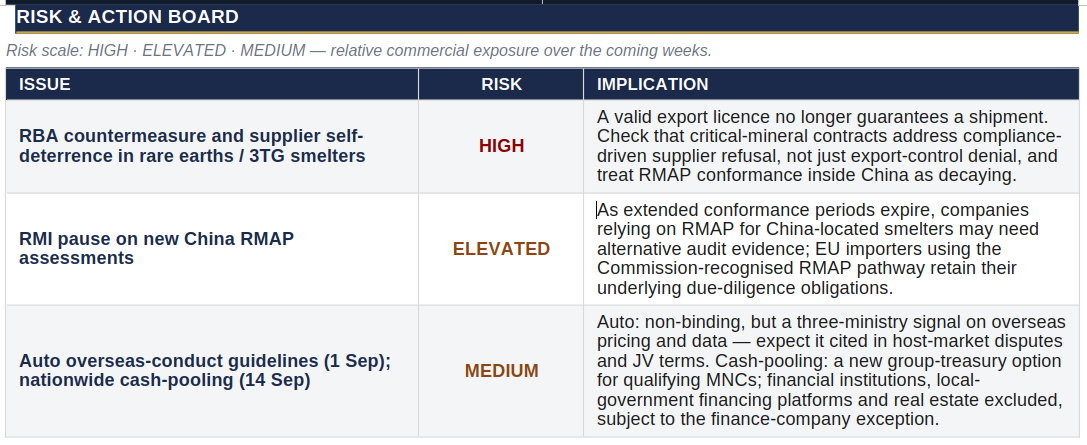
The trigger. On 5 August, MOFCOM Order No. 2 of 2026 placed the Responsible Business Alliance (RBA) and five other US entities on China’s countermeasure list under the Anti-Foreign Sanctions Law, after Washington added 43 China-based firms to the UFLPA Entity List on 31 July. The order bars organisations and individuals inside China from transacting or cooperating with the listed bodies. The RBA says its operations outside China are unaffected — but the prohibition lands precisely where its China audit work is done.
The hidden exposure. The RBA houses the Responsible Minerals Initiative (RMI), whose Responsible Minerals Assurance Process (RMAP) is one of the principal global due-diligence systems for mineral smelters and refiners. RMI has already moved: it is pausing new RMAP assessments in China and temporarily extending expiring conformance validity for China-located smelters and refiners while it assesses the order. The infrastructure multinationals use to prove clean supply chains now sits inside the sanctions perimeter.
The behavioural change. On 4 September, Reuters reported that a handful of Chinese rare-earth suppliers have declined to ship to US customers since early August, wary of Chinese repercussions for complying with the RMI diligence framework; Reuters could not determine how many. This is not another export restriction. An export licence is becoming necessary but no longer sufficient — the supplier’s own countermeasure exposure can override it.
Regulatory self-deterrence. Three compliance layers now collide: a Western customer’s responsible-sourcing requirement, the RMI/RMAP diligence that satisfies it, and China’s prohibition on dealing with the body that runs it. Rather than test where Beijing’s enforcement line sits, suppliers resolve the conflict by walking away. That is a harder dependency to engineer around than a quota, because the transaction disappears before any regulator has to act.
Beyond rare earths. The same three-layer collision reaches any supply chain that leans on RMAP or RBA audits — electronics, batteries, autos, aerospace and medical devices among them, several already reporting licence delays. With rare-earth access on the US planning agenda ahead of Xi’s expected 24 September visit to Washington, certification has stopped being a compliance footnote and become summit leverage.
Also This Week · Geoeconomics / Regulatory
Beijing Starts Regulating How Its Automakers Compete Abroad
Published on 1 September, the MOFCOM-MIIT-SAMR Guidelines for Overseas Competition Conduct and Compliance Development in the Automotive Industry — four chapters, 20 articles spanning overseas pricing, distribution, labour, product compliance and data, with explicit warnings against pricing that distorts competition. The text is non-binding and sets no penalties — a “public service product,” in MOFCOM’s framing — but it carries three senior ministries. The signal matters more than the mechanism: Beijing is shifting from urging firms to “go global” to policing how they behave once there, with direct read-through to BYD and the wider EV and battery ecosystem.
Cross-Border Cash-Pooling Goes Nationwide — 14 September
A PBOC/SAFE notice takes effect 14 September, letting qualifying multinational groups centralise RMB and foreign-currency cash, pool external-debt and overseas-lending quotas, and run a single account; more than 260 groups covering over 5,500 member companies had registered under the pilot by end-June. It lands one day before Decree 841 tightens exit-entry administration on 15 September — capital made more mobile on the 14th, the legal architecture around human mobility firmed up on the 15th. The treasury mechanics, quota limits and exclusions are the subject of Full Issue 10.
ANALYST ASSESSMENT
China’s countermeasure architecture has completed a quiet progression this year — from legal capability, to corporate behaviour, to transaction consequence. The rare-earth case is the clearest evidence yet that Beijing need not block a shipment to stop it; it need only make the compliance cost of shipping ambiguous enough that the supplier declines on its own.
Leverage has migrated from the border to the boardroom: the most effective export control is now the one the exporter imposes on itself. Into the 24 September summit window, buyers of Chinese critical minerals should plan for licences to flow while shipments still stall — and should assume contract language written for export-control risk does not cover compliance-driven refusal.
— Frank Matisse, Senior Analyst, Ascendancy Advisors Limited
COMING IN FULL ISSUE 10
The cross-border cash-pooling regime effective 14 September, read as a group-treasury instrument: what qualifying multinationals can now centralise, where the external-debt and overseas-lending quota mechanics bite, and who is excluded. For subscribers this week.
Subscribe: theaalgroup.com/subscription · Full archive: theaalgroup.com/reports
Official sources: PRC Ministry of Commerce (Order No. 2 of 2026; automotive overseas-conduct guidelines); People’s Bank of China and State Administration of Foreign Exchange (cross-border cash-pooling notice); State Council (Decree No. 841); Responsible Minerals Initiative (RMAP public-list notice). Reporting: Reuters.
© 2026 Ascendancy Advisors Limited. All rights reserved. Not for redistribution without written permission.