
Weekly Digest
THE JULY 1 COUNTDOWN: CHINA'S OUTBOUND INVESTMENT REGULATION

01 | WEEK IN REVIEW
Four regulatory developments warrant immediate attention this week. Together they extend the architecture of China’s national security economic toolkit into outbound investment governance — consolidating a fragmented agency-level landscape into a single, higher-authority legal instrument with materially expanded enforcement powers.
OUTBOUND INVESTMENT REGULATION ISSUED
State Council releases China’s first dedicated State Council-level outbound investment regulation — effective 1 July 2026. New security review mechanism, explicit technology and data transfer controls (Arts. 13-14), and countermeasure provisions targeting foreign parties that impede Chinese investors (Arts. 23-25).
ORDER 835 — FIRST FORMAL ACTIVATION
On 15 May 2026, China’s Ministry of Justice invoked Order No. 835 to designate the EU’s Foreign Subsidies Regulation investigation into Nuctech as constituting “unlawful extraterritorial jurisdiction.” First confirmed deployment of the counter-extraterritoriality framework since its April 2026 effective date.
SAMR TRADE SECRET PROVISIONS — LIVE
SAMR’s updated Trade Secret Provisions (analysed in CCIB Issue 4) entered into force 1 June 2026, expanding from 12 to 31 articles. Administrative enforcement on trade secrets is now a credible primary remedy, with fines up to RMB 5 million in serious cases.
ORDER 834 — ENFORCEMENT INTERPRETATIONS EMERGING
Independent legal analysis from Freshfields, Sidley Austin, Wilson Sonsini, and Morgan Lewis confirms Articles 13 and 15 of Order 834 structurally conflict with OFAC’s 50 Percent Rule and the EU CSDDD. Full analytical treatment in CCIB Issue 5 — dropping Wednesday 25 June.
02 | LEAD ANALYSIS
THE JULY 1 COUNTDOWN: CHINA’S OUTBOUND INVESTMENT REGULATION
What it is. Why it matters. Who is exposed?
On 1 June 2026, the State Council released the Regulation on Outbound Investment — China’s first dedicated administrative regulation governing outbound investment at State Council level. It takes effect in ten days, on 1 July 2026. The Regulation consolidates a fragmented landscape of agency-level rules issued by NDRC and MOFCOM into a single, higher-level legal instrument with markedly expanded enforcement powers and countermeasure provisions that materially alter the risk calculus for any multinational or investor with exposure to Chinese-origin assets, capital flows, or technology.
Why Now — And Why This Is Different
The Regulation’s official rationale — drawn from a joint Q&A issued by the Ministry of Justice, NDRC, and MOFCOM — is explicit: rising geopolitical risks and intensifying international competition mean the prior framework can no longer meet current needs. The signal is not diplomatic. It places on record that China’s outbound investment architecture is being re-engineered as an instrument of strategic competition, not merely commercial facilitation.
Three structural features distinguish the Regulation from its predecessor rules:
• Jurisdiction over non-PRC nationals — Article 2 defines ‘investors’ to include individual residents within China regardless of citizenship. A non-PRC founder whose startup operates substantial assets inside China may be captured by the Regulation whenever present in-country, even transiently.
• Technology transfer controls with criminal exposure — Article 13 closes the perceived grey area on indirect transfer routes, expressly prohibiting restricted technology transfers via personnel relocation, cross-border technical guidance, and overseas training programmes. Prior positions that such indirect methods were legally unaddressed are no longer defensible after 1 July.
• Countermeasure provisions mirroring Orders 834 and 835 — Articles 23-25 grant State Council agencies sweeping authority to respond to foreign discriminatory measures against Chinese investors, including import/export restrictions, investment prohibitions, and AFSL designation authority over individuals who participated in implementing such measures.
Articles 23-25: The Countermeasure Layer
The three countermeasure articles establish an escalating response framework targeting foreign parties that impede or discriminate against Chinese outbound investors. Article 23 addresses trade-linked investment barriers, empowering agencies to adjust investment policies or restrict imports, exports, or services to the relevant jurisdiction. Article 24 reaches discriminatory sovereign measures — framed as violations of international law or basic norms of international relations — with AFSL designation authority over individuals who participated in formulating, deciding, or implementing such measures.
Article 25 is the sharpest instrument: it targets any foreign organisation or individual who violates ‘normal market transaction principles’ by interrupting ordinary commercial dealings with Chinese investors, or adopts discriminatory measures that unreasonably deprive or restrict their lawful rights. Available countermeasures include import and export restrictions, investment prohibitions, and restrictions on Chinese entities transacting with the offending party.
The language of Article 25 is structurally identical to the countermeasure provisions in Orders 834 and 835. This convergence is not coincidental. The Outbound Investment Regulation extends the same enforcement architecture into a new domain: the management of Chinese capital and technology moving outward.
Technology and Data Transfer: Articles 13-14
Article 13 prohibits transfers of goods, technologies, services, or data subject to export control without a proper licence — explicitly including indirect routes such as personnel relocation, cross-border technical guidance, and overseas training. For non-PRC parties contemplating transactions involving Chinese-origin IP or sensitive data through offshore holding structures, Article 13’s explicit prohibitions create direct legal exposure. This is particularly salient in the context of US OBBBA ‘prohibited foreign entity’ restrictions, which have prompted some PRC companies to explore transferring controlling interests of offshore subsidiaries holding significant Chinese-origin IP to non-PRC parties. The Regulation makes such transactions legally complex on the PRC side in ways that did not exist before 1 July.
Article 14 confirms that cross-border data flows accompanying outbound investment remain governed by the Data Security Law, Cybersecurity Law, and PIPL. It requires a pre-investment assessment of whether the data involved constitutes core data, important data, or personal information, and determination of applicable transfer mechanisms before any investment proceeds.
The Security Review Mechanism
Article 15 establishes a cross-agency security review mechanism for outbound investments that may affect national security. Implementing regulations specifying scope, procedures, and review thresholds remains pending. The Regulation mandates that relevant organisations and individuals provide cooperation and comply with mechanism decisions, including ex-post-facto divestment orders for completed transactions under Article 28. The absence of implementing detail is itself a design feature: it preserves maximum discretionary authority for Chinese agencies over which transactions to scrutinise — mirroring the same ambiguity-as-enforcement-tool logic observed in Order 834’s Article 15.
03 | ANALYST ASSESSMENT
FRANK MATISSE, SENIOR ANALYST | ASCENDANCY ADVISORS LIMITED
The Outbound Investment Regulation is best understood as the fourth cornerstone of the legal architecture that China has been systematically constructing since 2021. The first three cornerstones — the Anti-Foreign Sanctions Law, MOFCOM Blocking Rules, and the Unreliable Entity List — addressed inbound exposure: what China would do when foreign parties sanctioned or discriminated against Chinese entities operating inside China. Orders 834 and 835 extended that architecture to supply chains and to counter extraterritoriality. The Outbound Investment Regulation now extends it to Chinese capital and technology moving outward. Each instrument is complementary; none is redundant.
Three practical implications for commercial practitioners and compliance officers follow. First, the window for completing Chinese-origin technology transactions involving OBBBA-related offshore restructuring is closing rapidly — the Regulation takes effect in ten days, and Article 13’s indirect transfer prohibition is immediate and without transition. Second, the countermeasure provisions in Articles 23-25 mean that any foreign party declining to transact with Chinese investors — for whatever reason, including home-country sanctions or export controls — now faces the same administrative escalation ladder that Orders 834 and 835 made available in the supply chain and sanctions compliance contexts. Third, the pending implementing regulations on the Article 15 security review mechanism will be among the most consequential Chinese regulatory publications of the second half of 2026. Practitioners should build monitoring capacity for these now rather than retroactively.
Assessment: The Regulation accelerates the timeline for conflict-of-laws exposure affecting all multinationals with China-facing investment strategies. Transactions involving Chinese-origin AI, advanced technology, and critical mineral assets merit immediate legal review against the 1 July effective date. The Article 15 security review mechanism and its forthcoming implementing regulations are the primary monitoring priority for the second half of 2026.
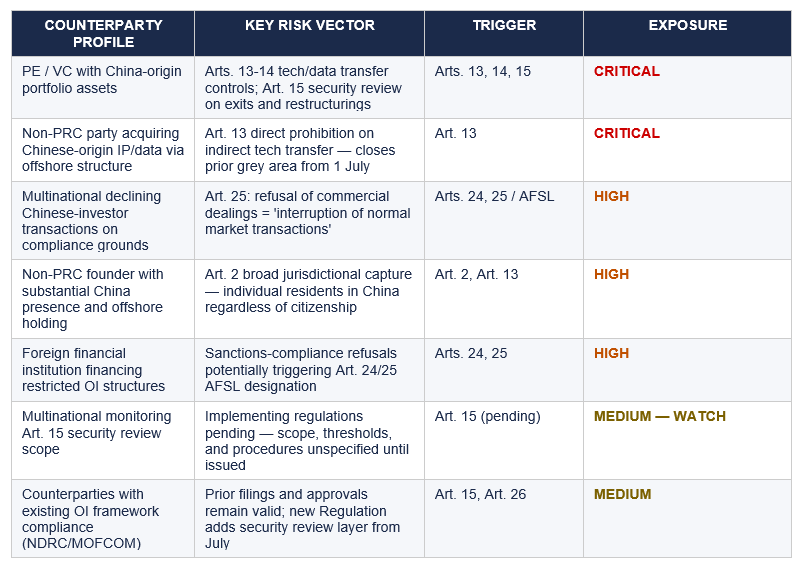
04 | RISK EXPOSURE MATRIX — OUTBOUND INVESTMENT REGULATION (EFF. 1 JULY 2026)
The matrix below maps principal counterparty and investor profiles against key risk vectors, trigger provisions, and near-term exposure levels arising from the Regulation effective 1 July 2026.
ISSUE 5 — DROPPING WEDNESDAY 25 JUNE
STATE COUNCIL ORDER NO. 834 & 835 — THE DEFINITIVE ANALYSIS
Issue 5 delivers a comprehensive examination of China’s compliance enforcement trap: how Orders 834 and 835, taken together, transform standard sanctions diligence and supply chain investigations into actionable offences under PRC law. Paid subscribers receive:
• Full text analysis of Articles 13 & 15 of Order 834 — the enforcement trap provisions in detail
• The Nanjing Maritime Court precedent and its escalation pathway to the Order 834 administrative track
• Sector exposure assessment: technology, financial services, logistics, energy, and critical minerals
• Interaction mapping: Order 834 vs. OFAC 50% Rule, BIS Affiliates Rule (Nov. 2026 reinstatement), EU CSDDD
• Order 835 enforcement mechanics: Malicious Entity List, Prohibition Execution Orders, and personal liability
• Practitioner action checklist: documentation, governance, and counterparty diligence — what to do now
Subscribe at ascendancyadvisors.substack.com
$29 / month·$290 / year·$500 Founding Member
© 2026 Ascendancy Advisors Limited. All rights reserved. Not for redistribution without written permission. | https://theaalgroup.com